 Mysteries
 The Woman Who Was Erased
A body burned in a Norwegian valley, eight forged passports, every label cut from her clothes. The first of a series — and the start of separating what's real about the Isdal Woman from what the internet invented.
On a Sunday afternoon in late November 1970, a man took his two young daughters hiking above Bergen, on the west coast of Norway, and found a dead woman in the rocks.
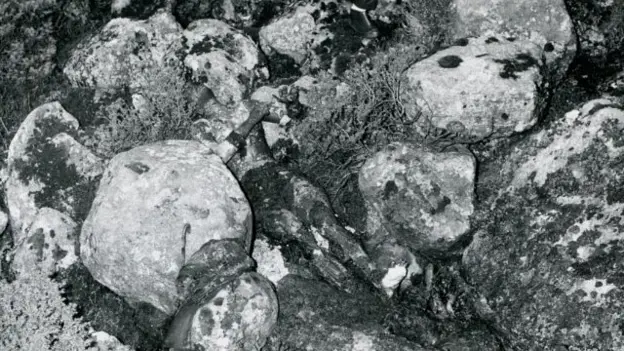
She was in Isdalen — Ice Valley — a steep, stony cleft on the slopes of Mount Ulriken. It is not a place you reach by accident; you have to want to be up there, or be brought. She lay on her back, badly burned, her face gone. Arranged around her, with a tidiness that has bothered investigators ever since, were the ordinary props of a life: a watch, two earrings, a ring, an emptied bottle of liqueur, a fur hat. What there was not, anywhere, was a name.
I came to this case the way most people do — through the legend: the mysterious cipher, the Cold War spy stories, the sense that somewhere in the file is a secret big enough to match the mystery. I’ll get to all of it. But I want to start somewhere less glamorous, because it’s the thing that actually tells you what kind of case this is. Before the code, before the isotopes and the espionage theories, one pattern organizes all the others: someone took enormous, patient trouble to make sure this woman could never be named. Some of that trouble was almost certainly her own — the aliases, the labels cut from clothes she wore while alive. Some of it happened at the scene of her death, and who did that work is the question this series keeps circling back to.
The erasure
Start with the clothes. Every label had been cut out — every maker’s mark, every laundry tag, the little woven rectangles that would let you trace a coat to a shop and a shop to a city. On a tube of eczema cream among her things, the brand name had been scraped away. No shop in Norway could match her wardrobe to a rack. She travelled across at least eight different identities, none of which has ever been tied to a real person.
This is not how people die. People die messy — they leave a wallet, a monogram, a next of kin, a receipt in a coat pocket. This death left nothing to grab: the work of someone who understood, in detail, exactly which small things name a person, and removed them one by one.
The erasure missed one thing. A partial fingerprint survived — on a pair of plain, non-prescription sunglasses in her luggage — and it matched the body. It was enough to tie her belongings to her. It was not enough to tell anyone who she was, because a fingerprint only names you if you are already written down somewhere. She was not written down anywhere. She still isn’t.
The kit
The same hand shows up in her luggage. Days later, police traced two suitcases she had checked into the left-luggage office at the Bergen railway station — linked to her by that same partial print. The sanitizing hadn’t stopped at her body; it extended to what she carried.
Wigs. Cosmetics. Clothes with the labels gone. Maps and timetables. Foreign banknotes — German marks folded into a lining — and a handful of coins from Belgium, Britain, Switzerland. And a notebook filled with code.
It is not a tourist’s baggage, and it is not quite anyone’s — the luggage of someone who moved for a living and expected, at any moment, to have her bag opened by a stranger.
The names
She had at least eight of them — Geneviève Lancier, Elisabeth Leenhouwer, Alexia Zarne-Merchez, and others, the spellings themselves uncertain because no two sources agree. She checked into hotels across Norway — Bergen, Oslo, Stavanger, Trondheim — and across Europe, generally claiming to be Belgian and filling the registration cards in German or French. She changed rooms, and sometimes cities, on a rhythm that reads — to anyone who has watched how people behave when they don’t want to be followed — a lot like counter-surveillance.
By every physical trace she was a real and specific person: about five foot four, dark hair, brown eyes, expensive dental work of a kind you didn’t get in Norway. By every documentary trace she was no one — a rotating cast of women who each existed for the length of a hotel stay and then dissolved.
What a sanitized file tells you
Here is the investigator’s point, and it’s why I wanted to open here instead of with the famous code. A file scrubbed this hard isn’t empty — the scrubbing is the evidence. When every label is cut and every name is borrowed, the absence is the finding. Somebody with training — or at least with ferocious discipline — worked to leave investigators nothing to pull on, and very nearly succeeded.
But discipline like this doesn’t only come from intelligence work. A woman running from a violent past, a courier, a con artist living on false papers would all have reason to scrub themselves this hard. What’s uncommon isn’t any one piece of it — it’s all of it at once, on the same person. That’s the part the tidy spy story tends to skip, and it’s the one I’ll keep in view: the erasure is real and deliberate; who she was erasing herself from is still open.
And then the file complicates its own story. The autopsy found soot in her lungs, which means she was breathing while she burned. It found a heavy dose of sleeping pills, and a bruise on her neck. Norwegian police closed the case as a probable suicide within weeks — and few who looked closely believed them. A woman does not usually cut the labels from her clothes and travel on a fistful of false names on the way to taking her own life. That ruling, and why a bad one sticks, is a chapter of its own.
The legend, and the job
In the half-century since, the theories rushed in. She has been named as Mossad, as KGB, as a Stasi courier; tied to secret missile trials and to a Nazi-financing banker; “solved” a dozen confident ways by people who never touched a primary source. A few of those threads trace back to something real and documented. Most of it is folklore — confident invention where the facts ran out.
That’s what this series is about. Not another retelling. I want to do the slow, unglamorous thing: separate the tradecraft-signal from the folklore, one piece at a time, and stay honest about which is which. The famous code that supposedly proves she was a spy — it was broken decades ago, and it isn’t what you think. The forensics that supposedly pinpoint where she came from — what they actually establish, and what they don’t. The espionage story, read by someone who used to do that kind of work. The suicide ruling nobody accepted. And then the part I care about most: what actually happens when an amateur with a laptop spends real time on a fifty-five-year-old case — before I say, held loosely, where I think the evidence points.
The erasure was so thorough that fifty-five years and a full DNA profile later, we still do not have her name. But a scrubbed file is still a file, and it talks — if you know how to read the silences.